
Assessment
What a 9 on Alva’s logic test means
A 93rd–98th percentile result, how Alva calculates it, and why one strong score is useful context rather than a complete definition of ability.
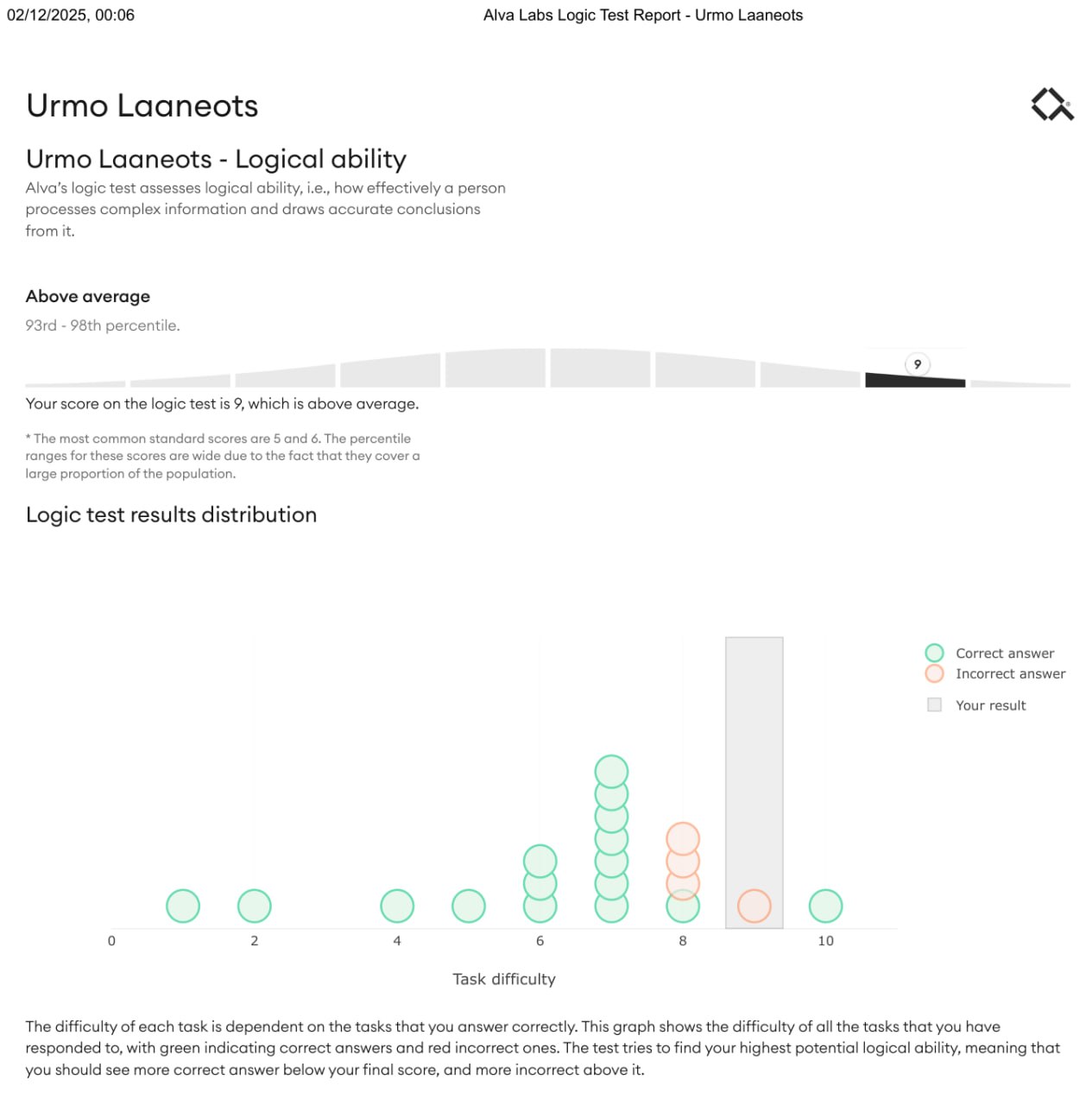
On 2 December 2025, I completed Alva Labs’ logic test. The report gave me a score of 9 out of 10, marked above average, with a percentile range of 93rd–98th. It is a strong result—but the number becomes more useful when you understand what the test measures and what it does not.
What the test measures
Alva describes its logic test as a measure of abstract reasoning: the ability to identify patterns, process unfamiliar or complex information, and draw accurate conclusions. The tasks use visual matrices rather than learned facts, specialist vocabulary or mathematical formulas. That makes the test less dependent on education and language than a conventional knowledge test.
The assessment is adaptive. Each answer helps determine the difficulty of the next task, so the test keeps searching for the level at which the questions are challenging but still solvable. Alva’s current format uses 20 scored tasks, each with a two-minute limit.
That adaptive design matters because the result is not simply the percentage of correct answers. Alva estimates the most likely level of ability from the difficulty of the questions and the pattern of correct and incorrect responses. Two people can answer the same number of questions correctly and still receive different scores.
Read how Alva’s logic test works and how the score is calculated.
Reading a score of 9
The result uses a standardised 1–10 scale designed around the working population. Most results sit near the middle, especially 5 and 6; results become less common toward either end. Alva classifies 8–10 as above average.
My report places 9 in the 93rd–98th percentile. In plain language, the estimate is higher than the result achieved by roughly 93–98% of the comparison population. That percentile is not “93–98% correct”, and the score is not an IQ score. It is a relative estimate for this particular kind of abstract problem solving.
The report’s distribution chart shows this process. Green circles are correct answers, red circles are incorrect answers, and their horizontal position represents task difficulty. The grey band at 9 is the final estimate produced from the complete response pattern—not a count of green circles and not merely the hardest item answered correctly.
Alva’s interpretation guide explains the standardised scale and percentile ranges in more detail.
Why it matters to me
Much of my work has involved turning incomplete technical signals into decisions: tracing infrastructure failures, assessing security risk, designing controls, prioritising incidents and explaining complex systems to people who need a clear answer. Pattern recognition and structured reasoning help in all of those situations.
A score of 9 supports something I have experienced throughout my career: I am comfortable entering an unfamiliar problem, finding the structure in it and moving toward a practical conclusion. In technical operations and information security, that can shorten the path from noise to the issue that actually matters.
But it is still one data point. Alva itself cautions that logical ability is not the only driver of job performance or career success. Experience, motivation, personality, values, domain knowledge, communication and the quality of the environment all matter. A strong test result does not replace those things, and it does not describe a whole person.
So I keep the result for what it is: useful evidence of one ability, measured on one day, through one kind of task. The real value is what I do with it.